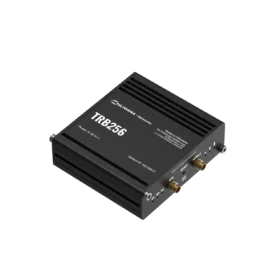

The TRB256 is an industrial 4G LTE NB-IoT gateway designed to be applied to a broad range of IoT solutions. The device is equipped with multiple WAN interfaces, such as I/Os, RS232, RS485, and an Ethernet port, additionally boasting dual SIM functionality for continuous connectivity. This industrial-grade gateway also supports the 450 MHz frequency band, offering superior LTE signal penetration compared to standard frequencies, making it an optimal choice for a diverse range of M2M applications.
4G LTE Cat M1 up to 588 DL/ 1119 UL kbps, Cat NB2 up to 127 DL/158.5 UL kbps, Cat NB1 up to 32 DL/70 UL kbps (simultaneous operation of cellular and GNSS connectivity is not supported)
Release 14
Operator block/allow list (by country or separate operators)
Band lock, Used band status display
Auto APN
Direct connection (bridge) between mobile ISP and device on LAN
Gateway assigns its mobile WAN IP address to another device on LAN
Static routing, Dynamic routing (BGP, OSPF v2, RIP v1/v2, EIGRP, NHRP), Policy based routing
Ping Reboot, Wget Reboot, Periodic Reboot, LCP and ICMP for link inspection
View device ports, enable and disable each of them, turn auto-configuration on or off, change their transmission speed, and so on
Visual representation of your network, showing which devices are connected to which other devices
Captive portal (hotspot), internal/external Radius server, Radius MAC authentication, SMS authorisation, SSO authentication, internal/external landing page, walled garden, user scripts, URL parameters, user groups, individual user or group limitations, user management, 9 default customisable themes and optionality to upload and download customised hotspot themes
Supported >77 service providers, others can be configured manually
DNS over HTTPS proxy enables secure DNS resolution by routing DNS queries over HTTPS
Real-time monitoring, wireless signal charts, traffic usage history
Preconfigured firewall rules can be enabled via WebUI, unlimited firewall configuration via CLI, DMZ, NAT, NAT-T, NAT64
Tag-based VLAN separation
Blacklist for blocking out unwanted websites, Whitelist for specifying allowed sites only
Flexible access control of SSH, Web interface, CLI and Telnet
Let's Encrypt and SCEP certificate generation methods
Multiple clients and a server can run simultaneously, 27 encryption methods
DES-CBC 64, RC2-CBC 128, DES-EDE-CBC 128, DES-EDE3-CBC 192, DESX-CBC 192,
BF-CBC 128, RC2-40-CBC 40, CAST5-CBC 128, RC2-64-CBC 64, AES-128-CBC 128, AES-128-CFB 128, AES-128-CFB1 128, AES-128-CFB8 128, AES-128-OFB 128, AES-128-GCM 128, AES-192-CFB 192, AES-192-CFB1 192, AES-192-CFB8 192, AES-192-OFB 192, AES-192-CBC 192, AES-192-GCM 192, AES-256-GCM 256, AES-256-CFB 256, AES-256-CFB1 256, AES-256-CFB8 256, AES-256-OFB 256, AES-256-CBC 256
XFRM, IKEv1, IKEv2, with 14 encryption methods for IPsec (3DES, DES, AES128, AES192, AES256, AES128GCM8, AES192GCM8, AES256GCM8, AES128GCM12, AES192GCM12, AES256GCM12, AES128GCM16, AES192GCM16, AES256GCM16)
GRE tunnel, GRE tunnel over IPsec support
Client/Server instances can run simultaneously, L2TPv3, L2TP over IPsec support
Proxy designed to add TLS encryption functionality to existing clients and servers without any changes in the program’s code
SSTP client instance support
ZeroTier VPN client support
Tinc offers encryption, authentication and compression in it's tunnels. Client and server support.
Client, Server
RTU (RS232, RS485), TCP
MODBUS TCP custom register block requests, which read/write to a file inside the router, and can be used to extend MODBUS TCP Client functionality
Allows sending commands and receiving data from MODBUS Server through MQTT broker
Firmware update from server, automatic notification
SSH (v1, v2)
OpenACS, EasyCwmp, ACSLite, tGem, LibreACS, GenieACS, FreeACS, LibCWMP, Friendly tech, AVSystem
MQTT Broker, MQTT publisher
SNMP (v1, v2, v3), SNMP Trap, Brute force protection
Teltonika Remote Management System (RMS)
Allows monitoring of: Device Model, Revision and Serial Number, WAN Type and IP, Mobile Cell ID, ICCID, IMEI, Connection Type, Operator, Signal Strength. Has reboot and firmware upgrade actions
Can be configured with Data to Server to send all the available parameters to the cloud. Has Direct method support which allows to execute RutOS API calls on the IoT Hub. Also has Plug and Play integration with Device Provisioning Service that allows zero-touch device provisioning to IoT Hubs
RutOS (OpenWrt based Linux OS)
Busybox shell, Lua, C, C++
SDK package with build environment provided
You can create your own custom, branded firmware and web page application by changing colours, logos, and other elements in our firmware to fit your or your clients’ needs
GPS. (GLONASS, BeiDou, Galileo and QZSS – under development); (simultaneous operation of GNSS and cellular connectivity is not supported)
GNSS coordinates via WebUI, SMS, TAVL, RMS
NMEA 0183
NTRIP protocol (Networked Transport of RTCM via Internet Protocol)
Configurable multiple geofence zones
2-pin in 16-pin industrial terminal block
9 – 30 VDC, reverse polarity protection, surge protection +/-1 kV 50 µs max
Idle: <2 W, Max: <3.5 W
1 x RJ45 port, 10/100 Mbps
1 x 16-pin terminal block
4-pin in 16-pin terminal block (TX, RX, RTS, CTS)
Reboot/User default reset/Factory reset button
EN 61000-4-2:2009
EN IEC 61000-4-3:2020
EN 61000-4-4:2012
EN 61000-4-6:2014
CE: EN IEC 62368-1:2020 + A11:2020, EN IEC 62311:2020
RCM: AS/NZS 62368.1:2022
CB: IEC 62368-1:2018